Orgonite: Powders vs. Shavings Which is More Powerful?
When I first started making orgonite, I was experimenting with different blends of powders. I was trying different combinations with: steel, brass, iron oxide, quartz and zinc oxide. I decided to use powder because it creates a more effective product. Like an electric capacitor the powders store more surface charge (per unit area) than beautiful stones or metal shavings. If the total surface area of a pile of copper metal shavings were that of an A4 sheet of paper, then if the pile were replaced by copper powder, then the surface area would be the size of a football field. This concept is also what makes small compact ultra-capacitors possible. In other words, powdered orgonite is in a league of its own.
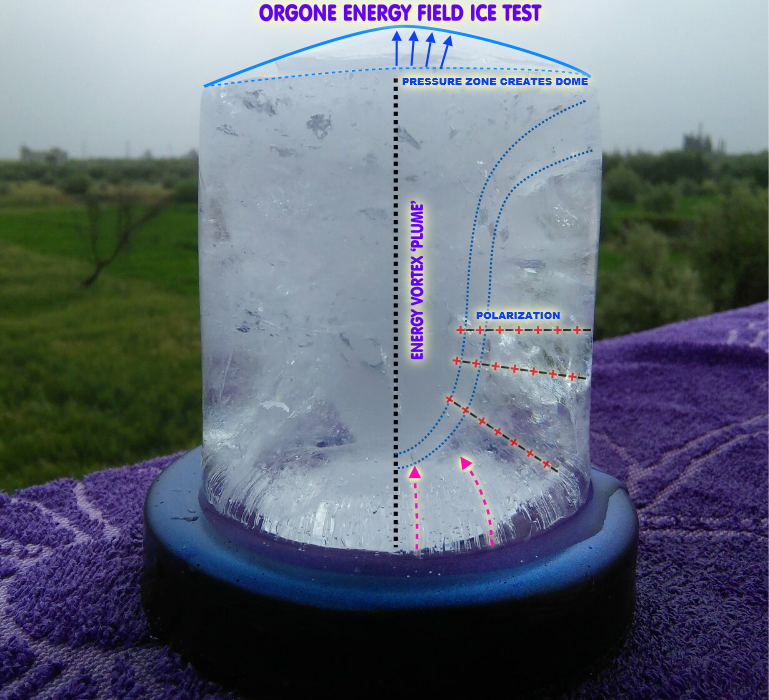
The most readily available way of testing the strength of an orgone plate, pendant, etc. is by what’s known as the ‘ice test’. You place a glass of distilled water above the device you are testing in a freezer. As the water freezes, a vortex ‘cloud’ (tornado) pattern emerges in the ice. This frozen pattern is a snapshot of the ‘standing or scalar field’ emitted from theorgonite. This is the orgone field (as defined by Reich), and its effects extend far beyond the glass container (the glass being a physical barrier) between the orgone device and the water. This field is also what sends chem-trails into the upper stratosphere with the right geometry. It is able to manipulate and structure the hydrogen bonds in water. As the water freezes, there is an asymmetric charge distribution within the ice emanating from the center of the glass (along the vertical axis) outwards. The center has positively polarized charged when compared to the ice at the rim of the glass. It is also where the ice is the densest, and the water is energized and structured. Consequently, the ice at the rim melts more rapidly than the center to melt much longer. If you are trying this experiment with spring water, you may find the melted water at the rim tastes saltier than the water melted from the cloudy structured center. In fact, the structured water is very pure, almost sweet to taste.
I was very fascinated with this phenomenon, as it appears that the stronger your orgone piece, the more densely ‘structured’ ice is formed. I encourage everyone to make orgonite and replicate this test.